Military Collections in Sweden – Third Chapter

The rich military tradition of Sweden can be retraced by means of many interesting dedicated collections. Many of them are scattered in the nice southernmost country regions of the Scandinavian peninsula, and make for an interesting detour from the most popular touristic destinations.

As reported in the previous two chapters on the topic (see here and here), the neutrality of Sweden in the major confrontations taking place during the 20th century allowed this northern Country to operate in a unique and original way, especially in terms of military procurement. Besides picking what was actually deemed suitable for their internal needs especially from the West, Sweden managed develop a strong domestic design and manufacturing capability, such to fulfill its own self-defense role in a cost-effective and credible way.

The defense of neutrality was carried out in the air by a strong Air Force, often updated over the years. With the end of communism in Eastern Europe and the collapse of the Soviet Union in the early 1990s, the major threat in the Baltic area came to an end as well, resulting in a major scale-down of this defense force and the disbandment of many military organizations. Correspondingly, memorial museums can be found often close to former airbases. One of them, dedicated to the ‘Scania’ wing F10, in operation since WWII to the early 2000s, is covered in this chapter.

A rather complete collection of aircraft from the entire span of the Cold War can be found in the unusual frame of a private museum, established in the 1960s from the will of the founder to display primarily his own collection of cars. The mix is particularly interesting, witnessing also the close link between Sweden and the vehicle industry of the US, possibly the tightest among all Countries in Europe.

Of course, in the theater of WWII Sweden was politically and geographically in an interesting position as well as later in the Cold War. Its relative proximity to the Third Reich meant it was often overflown by bombers on their way back from missions over mainland Germany. Dogfights and bomber chase missions reached the airspace of Sweden, sometimes ending with either German or Allied aircraft crashing on Swedish territory. An interesting museum covered in this chapter is fully dedicated to the topic.

Photographs in this chapter were taken in the summer of 2024.

Navigate this post – Click on links to scroll

Sights

Ängelholms Flight Museum, Ängelholm

This nice collection of military aviation can be found on the former premises of the air base of Barkåkra (today Helsingborg airport), which has been the home of the 10th Wing ‘Scania’ (aka. F10 or ‘Ängelholm Wing’) between 1945 until the disbandment of the latter in 2002. Established during WWII, the illustrious history of the F10 wing spanned the entire Cold War, reaching into the 21st century. Correspondingly, the Scania Wing was supplied over the years with a rich inventory of aircraft models, ranging from classic fighters of WWII to the more recent SAAB Viggen and Gripen.

The structure of the exhibition, rather compact in size, is composed of two major areas.

In the first, the history of F10 is retraced especially by means of interesting photographs and memorabilia items. Among the pictures, some portray American bomber crews as well as German fighters landed on Swedish territory, which remained neutral during WWII.

In this area are also a few dioramas and reconstructions of typical military scenes, including a medical room, from the earlier days of operation of the Scania Wing. Everyday items, as well as military training and illustrative material, is presented in display cases.

The second major area is where most hardware of the collection can be found – aircraft, engines, vehicles, and much gear from the days of operation of the F10 wing. Among the earliest models acquired by F10 back in the WWII years was – rather interestingly – an Italian fighter, the Reggiane Re-2000 Falco, a batch of which was obtained from Italy in a supply shortage scenario, where especially the US had halted material export to non-allied countries. Pressed into service with the Air Force of Sweden (and specifically also with the F10 wing) as an interceptor with the locally attributed code of J20, this generally adequate machine was powered by a Piaggio P.XI 14-cylinders radial engine (which according to Roman numbering then often employed in Italy translates into P.11), a 1.040 hp model license-made in Italy, and originally a French design by Gnome-Rhone. A Re-2000 is not on display, but a Piaggio P.XI is! This engine has been quite popular in those years in Sweden, ending up also as an interim power plant for the Swedish own SAAB B17C single-engine light bomber/diver (not to be confounded with the homonym American Flying Fortress).

Close by the P.XI is the oldest aircraft on display belonging to the F10, in the form of a FFVS J22. The company FFVS was actually a Swedish state-managed entity, borne in the years of WWII to cope with the wartime supply requirements on one side and the overbooking of the SAAB plants on the other. Introduced during WWII, this rugged fighter was powered by a Pratt & Whitney R-1830, the ubiquitous Twin Wasp, license-built in Sweden by Svenska Flygmotor. The Scania Wing received the J22 model only in 1945, the last propeller-driven aircraft in its inventory. The exemplar on display looks under maintenance, and is possibly in airworthy conditions.

Next on display is a SAAB J29 Tunnan, with its distinctive barrel-shaped fuselage enshrouding the single, centrifugal flow jet engine. The F10 wing transitioned to jets in 1946 with the early SAAB J21R and the British-supplied DeHavilland DH100 Vampire (named J28R in Sweden). The Tunnan was provided to the F10 wing in 1953, and there it remained until 1963, while more advanced models were becoming available. The engine of the J29 was a DeHavilland Ghost, manufactured under licence in Sweden by Svenska Flygmotor under the name RM2B – an example is on display.

Close to the tail cone of the Tunnan is also a DeHavilland Goblin engine, originally employed on the Vampire.

The longest-lasting workhorse in F10 service has been the SAAB J35 Draken. An exemplar of the J version, the most updated and last (with the actual modification taking place in the late 1980s), is on display. The distinctive bulge for the IR seeker under the fuselage, appearing from the modern F version on, can be checked out from very close.

Interestingly, the Draken is presented with an exemplar of the Rb-28 missile hanging from an underwing pylon. This is a SAAB-modified version of the US-designed Hughes AIM-4D Falcon, an air-to-air missile conceived as an anti-bomber weapon, but hastily pressed into service against Vietnamese MiGs during the Vietnam war, under the wings of the Phantom, and proving very ineffective in the dogfighting role. For the Soviet bomber interdiction role of the Draken, this missile platform was deemed more effective, and it was retained for service for decades in Sweden.

Other missiles, rockets and guns (including a dismounted Aden 30 mm cannon) pertaining to the warload of the Draken are on display as well, together with an interesting console for missile signal testing.

Ahead of the Draken is a memorial wall, and ahead of it is a Rolls-Royce Avon jet engine, displayed as an instructional cutaway – including both the turbomachinery and the afterburning component. License-built in Sweden by Svenska Flygmotor as RM6C, this was the engine of the Draken.

The F10 wing received the SAAB J37 Viggen only after the collapse of the USSR in 1993, marking the beginning of the last, post-Cold War chapter in the history of the unit. Quite elusive due to its adoption only by Sweden, albeit rather successful in its intended roles, an exemplar of this machine can be found in this collection. Specifically, this is a photo reconnaissance version named SF37. Lacking a radar, this model typically operated on reconnaissance missions in a flight of two, together with a radar-supplied SH37 variant.

The Viggen can be neared and checked out entirely with ease, thanks to its positioning on a pedestal. The photo-reconnaissance payload is on display. Under the left wing is a SAAB Rb-04 anti-ship missile. This Swedish own design was conceived for countering invasion starting from the sea. With a radius of 25 km and active radar homing, its warhead was sufficient for knocking out an enemy cruiser with a single hit.

The collection of the Scania Wing also includes the SAAB SK60 trainer, a successful trainer employed for decades, and inducted into the F10 inventory during the 1990s, when the wing took over the basic training role from the F5 wing. Similarly, an ubiquitous Bell 204 (Hkp 3B according to Swedish naming) can be found on display, as it was employed within the F10 for rescue and logistics/transport duties.

Close to the Viggen are further interesting exhibits. One is on the wartime bases (krigsflygbaser, see this post), with models and original signs from one of them.

Another is about weather forecasting within F10. It includes electronic hardware, an entire room with original consoles, and weather balloons, still today employed to carry atmospheric sounds.

A display is dedicated to pilot’s protection helmets, survival kits and ejection seats. Not only in Sweden, the latter have been in the focus of a major technological development over the years of the Cold War. Ejecting from a fast jet in the 1950s was reportedly a highly-risky business, since even when the maneuver was technically successful – i.e. such to take the pilot out of the aircraft alive – the ejection-induced acceleration alone was more than enough to cause serious injury, usually to the spine. Over the years, multi-stage ejection was implemented, allowing for a more gradual maneuver, which albeit remaining lightning-fast, does not inflict so harsh a treatment to the pilot’s body as in the past.

A top exhibit on display is an original cockpit from a SAAB J35 Draken, employed for training purposes. The cockpit is very well preserved, thoroughly described by explanatory panels nearby, and it can be boarded to give you a feeling of the functionality of the onboard systems, as well as of the ergonomics of the cockpit.

Two more training aircraft are included in the exhibition, a SK61 and SK50, both single-propeller machines employed for basic training.

Additionally, the last type in service with the F10 has been the SAAB JAS39 Gripen (from 1999 until disbandment), which is here represented by means of the first serial production machine of the first version (‘A’). This exemplar was actually never pressed in air force service, but it was employed as a test bed for multiple operations, including test firing of missile ordnance in the early 2000s.

Additional dioramas in this compact but rich collection include op-rooms from various ages.

An interesting exhibit is a relatively well-preserved Rolls-Royce Merlin piston enigine, originally powering a British Avro Lancaster bomber which sank south of Trelleborg in the Baltic Sea, presumably early in 1945 after a bombing run over Germany.

Finally, on the outside it is possible to find a British Bristol Bloodhound Mk II missile. This SAM supplied a squadron of F10 wing, complementing the air defense role in proximity to the airbase.

Getting there and visiting

The name of the museum in the local language is Ängelholms Flygmuseum, which translates into Ängelholm Flight Museum. It is located on the southwestern border of the former airbase of Ängelholm, easily reachable at the address Drakenvägen 5, 26274 Ängelholm. This town is 15 mi north of Helsingborg along the E6 highway.

Large parking ahead of the entrance. Nice shop with books, toys and gadgets by the ticket office. The museum facility is rather compact, yet a visit may easily take 1.5 hours for an interested subject, when carefully checking out all items on display and taking pictures. Descriptions are in double language, Swedish/English, allowing for an informative visit even if you are from abroad.

Professional website with full information here.

Museum of Forced Landings, Morup

The Museum of Forced Landings (in Swedish language the museum is named in a rather different way, ‘Morups Samtidsmuseum’) is a one-of-a-kind collection of remains and traces from air crashes or forced landings taking place during WWII in Sweden. Run by a lively group of dedicated enthusiasts, the display is extremely well-crafted, offering not just an array of many and diverse relics from aircraft wrecks, but for each of them a complete synopsis of the story behind that specific flight – and the crewmen who were on board.

Furthermore, in my case I was accompanied by a very knowledgeable English-speaking gentleman for the entire duration of my visit, making the experience even more engaging.

The exhibition starts with a display of general maps of the crash or forced landing sites. A sharp increase towards the end of the war is evident, due to the increase in the number of bombing raids over the center of the Third Reich. The crashed aircraft are mostly from the US and Britain. When hit over Germany but still airworthy, Allied crews attempted an escape to neutral Sweden, to avoid capture by the Germans.

Of course, Sweden was a neutral country, hence all grounded crews, irrespective of their nationality, were interned, albeit in more than decent conditions, especially compared to German or Soviet prison camps.

A map of the internment location in Sweden is presented as well. Clearly, also German aircraft crash-landed in Sweden. Crews of opposing nationalities were interned in totally different locations. Rare photographs from these sites are on display.

Then, one by one, the display cases describe each a notable forced landing, retracing its timeline, and showing some relics from the wreckage, as well as personal items belonging to the crew. Nice detailed scaled models and dioramas of the accident complete the reconstruction.

Among them are a German Messerschmitt Bf110 attack aircraft, with a fragment of the canopy as well as other parts on display, Norwegian training aircraft, a German Junkers Ju-52 transport, with an entire control column put as an exhibit.

The bombsight, radio and other instrument goggles belong to a German Heinkel He-111 bomber landed on ice.

One of the plots documented in the deepest detail is that involving Lt Edward E. Phillips, of USAAF 354th fighter group, which flew escort missions over Germany from Baxton, England, with North American P-51 Mustang fighters. On the 15th of April 1944, on return from a mostly failed bombing mission over Germany in bad weather, Lt. Phillips aircraft was chased north by a Bf109. He was hit over southern Sweden, bailed out but the parachute failed to deploy. He was killed instantly, and his aircraft impacted soft terrain and sank so deeply due to its own energy that it almost disappeared into the ground – and there it remained for 40 years. In the 1990s an excavation attempt was carried out by the future crew of the museum, uncovering substantial remains of the aircraft, including many parts, cockpit gauges, machine guns, an entire landing gear leg, and more.

A link was established by the local crew with the former wife of the man in the US, and the story hit the news. A memorial was inaugurated on the location of the crash.

Another American aircraft with a story to tell is a Consolidated B-24 Liberator. This time the aircraft managed to crash land under control, and the entire crew of 10 was saved and interned. Sgt Robert C. Birmingham, part of the crew, visited the locations of his adventure in Sweden more than once with his family.

More accidents described in the display involve British and German aircraft.

In an adjoining room, an impressive collection of quality scale models reconstruct many of the aircraft in service within the Air Force in Sweden, including details such as different celebration markings and camo coats. Among the artifacts and memorabilia items on display in this part is an autographed photo of WWII German ace Günther Rall.

In another small hangar is an interesting addition to the collection, mostly centered on aircraft engines. Engines from crash-landed aircraft, significantly damaged but undergoing a display-oriented cleaning and refurbishment, make for an unusual and interesting sight.

Outside is also a small collection of classic cars in pristine conditions.

Getting there and visiting

The museum is called ‘Morups Samtidsmuseum’ in Swedish language. It can be found right along the road N.768 about 6 miles north of the coastal town of Falkenberg, 0.25 miles north of the small town of Morup. The exact address is X9MP+84 Morup.

A visit may take about 1 hour, more when stimulating further telling by the very enthusiastic crew of the association running the museum.

Please note that no credit cards are accepted, only cash is – unless you are entitled to employ electronic payment methods allowed for citizens or residents of Sweden.

The website, partially under construction as of spring 2025, can be found here.

Credit for directing me to this hidden gem goes to Martin Steffen, from Sweden.

Svedino’s Automobile and Aviation Museum, Ugglarp

This unusual exhibition originates from the own collection of Lennart Svedfelt, a prominent Swedish stage and TV entertainer borne in 1924 and known as ‘Svedino’. The man started purchasing cars and planes for the purpose of collecting them, in an era when a similar activity was hardly heard of. In 1961 he opened his collection as a permanent display, the first museum dedicated to cars in Sweden. Over the years, and even following his passing, the museum continued to grow, reaching more than 100 cars and 40 aircraft on display today!

Even though this is not an eminently military museum, despite the cars being beautiful civilian cars, most aircraft on display are military machines, including some remarkable items – therefore, Svedino’s perfectly fits within this chapter!

The cars on display make for a really unique collection, in and out of Sweden. A remarkable feature is especially the number and uniqueness of US-made cars from the inter-war period between WWI and WWII. In a first building, these include models by Chevrolet, Buick, Dodge, Nash, Oldsmobile, and more!

Also some classic models from European manufacturers, like Opel, are on display. A special rarity is an Adler Trumpf from 1934. Adler, a German company from the 19th century active in the manufacture of petrol engines, operated in the car market for a relatively short time, roughly coincident with the Third Reich period. They made cars in the intermediate price segment, with good success. The company changed business following WWII, making Adler cars interesting collectible items representing car-making from a specific era.

As expected from a Swedish museum, a full array of classic Volvo is on display! These include small trucks and saloons, and interesting models like the PV36 from the inter-war period. Similar to the PV830 and the iconic PV444 from the immediate post-WWII years, an influence of the contemporary American designs is undeniable in all these models.

Also on display are more modern vehicles employed as state cars. An interesting item is a very old Gräf & Stift, an Austrian luxury sedan from before WWI, salvaged from the bottom of a Swedish lake after spending there more than 40 years, and acquired by the museum.

Two interesting cars on display are personal designs from the early 1950s. In Sweden it was possible at that time to introduce privately-built cars, provided they could sustain a compliance check. An example of a fantasy car, with a rather aggressive design and physically assembled from parts of other cars, is on display. It was never completed nor allowed on the road. Another example, designed and made by the son of the industrialist Wennberg, reportedly roamed around all over the 1950s! This unique exemplar is on display with ‘factory markings’ HW.

In a second adjoining building, a really valuable collection of even older cars, dating from earlier than 1930, is on display. Also here most items in the collection are from the US, a really rare sight on this side of the ocean! Looking at the elaborated labels of these oldies, made by Ford, Anderson, Seneca, and thinking of the craftsmen who personally assembled them back in the America of the early 1900s is really thought-provoking!

Among the most unique cars on display is a Pierce-Arrow from 1918, sitting alongside a Haynes from the same year.

Moving on to another adjoining hall, here cars are on display alongside a few classic planes from the first half of the 20th century. A DeHavilland Moth, a Götaverken GV-38 seaplane (a licence-built Rearwin Sportster, a US design), as well as a German Klemm Kl-35 and a Focke-Wulf FW-44 designs, are on the list together with more light airplanes and a few engines.

The latter include an original Rolls-Royce Goblin and Avon, respectively from a DeHavilland Vampire and a SAAB Draken, both in service with the Air Force of Sweden during the Cold War.

A focus of the exhibition is on the memory of a pioneer of Swedish aviation industry, Enoch Tulin, who is the author of many ‘firsts’ in the aeronautical history of this Country – the largest aviation workshop to date before WWI (with 900 employees), the first air mail service, the first air rescue mission, and more. A graduated engineer, flight instructor and early aerobatic pilot, Tulin died in an airplane crash in 1919, after gaining unquestioned prominence in many fields of aeronautical industry and operation in his era.

A final adjoining hall concludes the oldest part of the exhibition premises. Here the spotlight is on a few fighters from the Cold War era, namely a SAAB J29 Tunnan, two DeHavilland Vampire, and even a SAAB J35 Draken.

The latter is really a unique exemplar. As can be guessed by the monstrous red and white spine on the nose cone, typical to experimental aircraft and not a feature of the production machine, the one on display is actually the first prototype!

Another curious item is a Soviet-made Kamov Ka-26 helicopter. Alongside the helicopter is a vintage advertisement from 1975, written in Swedish, and made by Aviaexport, a Soviet agency for the commercialization of Soviet aeronautical products abroad. Borne as an import-export, Aviaexport acted also as a recipient of foreign certification rules, spreading the growing body of western aeronautical regulation within the Soviet design bureaus, to the aim of keeping the quality standard to a level sufficient for commercialization in foreign countries. Actually, thanks to Aviaexport the Kamov Ka-26 received a type certification in Sweden, which allowed its commercialization and regular employment there. Aviaexport is still existent in today’s Russia.

Interspersed between closely-packed aircraft are more cars, including a beautiful Jaguar Mk V and an East-German Trabant, as well as aircraft engines.

A massive Wright Cyclone R-3350 is among them – the power plant of the Lockheed Constellation and Douglas DC-7, often considered the pinnacle and swansong of American piston power, this massive 1.2 tons, 18 cylinders engine produced 3.700 hp of shaft power!

Svedino’s aircraft collection is mostly hosted in a modern hall added more recently beside the original museum’s building. The first item on display is an original Junkers Ju-52! This aircraft is among those license-built in Spain. It operated for some time as far as in California in the 1970s, being later transferred to Ireland, and finally here. The camouflage and markings reenact those of a Third Reich’s Luftwaffe machine force-landed in Sweden during WWII. The cockpit of the Ju-52 has been reproduced separately, to allow checking it without boarding this precious aircraft.

As expected for a Swedish aircraft collection, the most prominent models which have served in the local Air Force are represented. These include a SAAB J32B Lansen, a Cold War attack aircraft from the 1950s, a SAAB SK60 trainer, and a SAAB J35 Draken – a production machine, not a prototype like in the previous hall.

These aircraft are presented alongside their engines. The Swedish licence-built version of the Rolls-Royce Avon, named RM6A, powered the Lansen and later the Draken.

The latest addition to the SAAB heritage on display is the J37 Viggen, here presented in the nice and distinctive camo coat of the Air Force of Sweden. This is presented alongside its mighty engine, the RM8A, a modified version of the Pratt & Whitney JT8D turbofan.

Additionally, a display of an open nose cone allows to see the arrangement of the radar antenna of the Viggen.

An interesting display case hosts the instrument panels, radar and reconnaissance gear of the Lansen, Draken and Viggen, as well as a collection of flight helmets and pilot’s gear, showing the evolution of this technical material over time.

But the collection of Svedino’s is not limited to aircraft in service in Sweden. A Lockheed F-104 Starfighter from the Air Force of Denmark is on display, next to a Gloster Meteor early twin jet. The blue exemplar on display is a former factory demonstrator originally employed by Gloster, and later sold to Sweden for target towing (in a batch of seven aircraft).

A rarity to be found close by is a Percival P.66 Pembroke, a twin-engined multi-purpose transport from the early 1950s, employed for training and passenger transport within the Air Force. Manufactured in Britain in just 128 exemplars, this type was mostly sold abroad to Western-European Countries and in Africa. Sweden originally got a batch of 16.

Another British type on display is a Hawker Hunter, which was actually employed by Sweden as a stop-gap model in the late 1950s, waiting for the completion of the design and the entrance into service of the J35 Draken.

Another Soviet addition to the collection is a MiG-21. A Cold War veteran, this exemplar is Soviet-built, and served in Hungary until 1982 and later in the Latvian SSR.

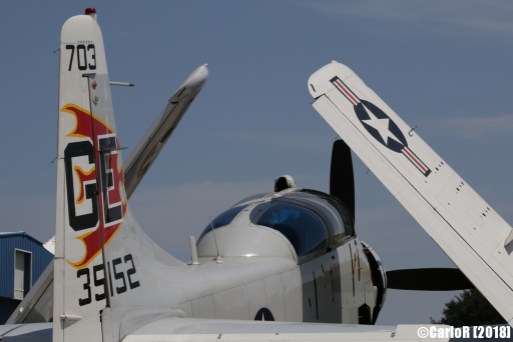
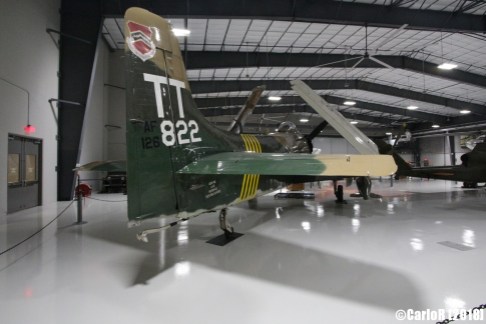
A recent addition to the exhibition is a Douglas Skyraider! Possibly overshadowed by the illustrious career the type enjoyed in the US Armed Forces, a part of the history of this massive attack aircraft is about Sweden. Some 13 exemplars were actually purchased by Sweden for target towing in the mid 1960 from Britain, which had got a larger batch from the US. The exemplar on display is an AD-4W, the early warning version of the Skyraider. It is currently (2024) being refurbished.

Among the biggest additions to the aircraft collection is actually an English Electric Canberra. As typical to this type, employed by the British for the first, high risk overflights of the Countries of the Soviet bloc before the high-performing Skunk Works aircraft became available, the Canberra (including its modified Martin version in the US) was employed for quintessentially Cold War signal intelligence missions opposite the Soviet Union. Two exemplars were employed also in Sweden from the early 1960s until the mid-1970s, and one of them is that on display.

A curious item also on display is a one-off design which won a competitive call of the Aviation Engineering Association in Stockholm in 1988, and which was later actually built by its designers. Unfortunately, it was eventually never tested due to one of the owners need to quit for health issues when the aircraft was undergoing a certification test for obtaining airworthiness. The name of the prototype is LLS-1.

Scattered among the aircraft are more engines, radars, consoles, simulators, and more aircraft than described, making for an overall very rich and interesting visit.

Getting there and visiting

Svedinos Bil & Flygmuseum – this is the name of the museum in the local language – can be found in a nice countryside 15 miles north of the port town of Halmstad. The exact address is SE-311 69 Ugglarp.

The premises are rather compact, with a large parking ahead of the entrance. Fresh cookies, homemade sandwiches and cakes are available for a light lunch in the exotic lobby, matching in style with this unusual collection.

A visit may take 2 hours for an interested subject. Most items are described with modern panels in double language Swedish/English, making the visit very informative. The website with logistical information is here.

Warbirds in Texas

The immense state of Texas is in the foreground of the panorama of historical aviation, thanks especially to the CAF – the Commemorative Air Force (website here) – which maintains and operates some of the Nation’s finest airworthy warbirds. This privately financed, non-profit organization feeds the programs of many airshows everywhere in the US, and carries out an invaluable function in preserving the legacy of many aircraft designers, manufacturers and military servicemen especially from WWII and early Cold War years.

The birth of the CAF in Texas is not just by chance. The Lone Star State bolsters an extremely long and rich tradition in aviation. Training airfields were established in Texas earlier and in a number greater than any other State during WWI. Fort Worth was the birthplace of one of todays few surviving major airlines in the US – American Airlines – back in the early 1930s.

Aircraft manufacturers associated with Texas include Consolidated – most of the iconic WWII B-24 Liberator bombers  were manufactured in Fort Worth – and North American. Consolidated later merged into Convair, owned by General Dynamics since the Fifties. Many aircraft of the Cold War era were actually manufactured in Fort Worth, including the record-breaking B-36 Peacemaker and B-58 Hustler, or the highly successful F-16 Fighting Falcon, still in service today in many air forces of the world, as well as a good deal of other types. As of today, Lockheed Martin and Bell Helicopters are both headquartered in Fort Worth.

Needless to recall, Houston has been one of the major focal points of world astronautics since the beginning of the space age.

In such a cultural setting, and considering the general financial wealth and the abundance of oil typical of Texas, it is not surprising that warbirds, even though fuel-thirsty and expensive to maintain, are present here in an exceptional concentration. Where possible, they are maintained in airworthy conditions, otherwise they are kept in great consideration in world-class air museums.

This post covers only four rich collections out of the many you can find in Texas. Two of them are ‘airworthy collections’, whereas in the other two warbirds are preserved for static display. Considered together, these four sites are probably already a good reason for an aviation-themed trip to Texas!

Photographs are from an extremely hot August 2018.

Navigate this post – click on links to scroll

Cavanaugh Flight Museum, Addison, TX

This renowned collection just west of downtown Dallas is split between a big group of exceptionally well-kept and airworthy prop-driven aircraft, and a number of warbirds on static display, some of them jet-powered. Website here.

The museum occupies a few hangars on a very busy general aviation airport (Addison Airport), where executive jets, helicopters and smaller propeller-driven aircraft operate all around the clock. 

The collection is hosted in four hangars and on an external apron where you can walk around freely. Not all aircraft are around here at any time, some having been flown out to some airshow, or for maintenance. In the first hangar you can find a handful of perfect airworthy replicas of WWI fighters from both sides of the front line.

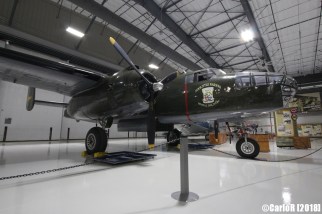
Just besides are a North American B-25J-NC Mitchell, a ground strafing version of the famous medium-range bomber, and a veteran of WWII.
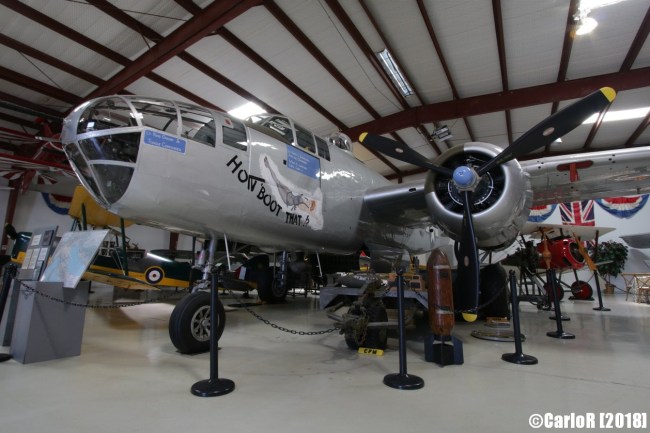
There are also a Vultee SNV-2 Valiant, a De Havilland Tiger Moth, a Ryan PT-22, all training planes from the Forties. In a corner you can see also a Piper L-4J, the military version of the J-3 Cub, and a Stinson L-5E, similar to the former in shape and mission type.

A Pitts Special aerobatic biplane is hanging from the ceiling in an inverted attitude.

The second hangar hosts a Fairchild PT-19 Cornell, an ubiquitous US military trainer from the Forties, in a distinctive light blue colorway with a yellow fin. Together with a yellow Stearman N2S-4 Kaydet biplane and a North American T-6 Texan, both good old trainers, they share the scene with a handful of stunningly preserved icons from WWII.

These include a Grumman F-4 Wildcat and a massive Grumman TBF Avenger – both in the dark blue colorway of the US Navy. 

Just besides are a licensed version of the Messerschmitt Bf-109G of Nazi Germany built by Hispano Aircraft in Spain, and a nice replica of a Soviet Yakovlev Yak-3M.

Cross the apron, you can find some more great classics from the Forties. There are an immaculate Curtiss P-40 Warhawk, and two North American T-28 Trojan trainers in the colors of the Navy. In the background you can spot a sizable Heinkel He-111 twin, a licensed version manufactured by CASA in Spain.

The last hangar shelters an aggressive Douglas A-1H Skyraider in the colors of the USAF. This version of the massive single-prop features a single seat and is especially reinforced for increased bomb load to carry on ground attack missions.

This is surrounded by a series of pretty famous jet attack aircraft, including a McDonnell-Douglas F-4C Phantom II, a North American F-86 Sabre and a Grumman F-9F-2B Panther with foldable wings and the distinctive blue and red colors of the Navy. 

There are also two classic fighters from WWII, a Supermarine Spitfire Mk.VIII and a North American P-51D Mustang. The latter is so polished that you can clearly see your image reflected in its skin panels!

On the outside apron you can see parked three Soviet-made jets from WWII – a MiG-15 UTI and a MiG-17 in the colors of the Red Army, and a more recent MiG-21 in the colors of the North Vietnamese Air Force. Close by, a PZL Iskra trainer, once ubiquitous in the former Soviet bloc.

There are also a Lockheed F-104A Starfighter, a Grumman S-2F-1 Tracker patrol aircraft of the Navy with folded wings, a Republic F-105 Thunderchief awaiting restoration, and a Vought A-7 Corsair II.

Scattered around the museum are also a few helicopters, and even a Sherman tank.

During my visit I could see two movements of aircraft taxiing out for take-off. The first was a Cessna O-2 Skymaster, a model extensively used in Vietnam for FAC missions. This has been refurbished with fake underwing rockets. You can see it in the vid below.

The second was a Douglas EA-1E Skyraider in gray Navy colors. This is the early warning version, designed for a crew of three and originally mounting a dedicated radar platform. You can watch (and hear!) the difficult startup of the huge Wright radial engine – it was around 100°F outside! –  and the aircraft taxiing with folded wings. Unfolding starts only seconds before the aircraft gets out of sight.

Forth Worth Aviation Museum, Fort Worth, TX

This museum hosts a little but highly valuable collection of US aircraft on static display. The museum is totally volunteer-run. These folks are doing an exceptional job preserving their aircraft. As you can see from the pictures, there are many exemplars being actively refurbished in a hangar to the back. The museum is located on the southeast corner of Fort Worth Meacham general aviation airport. Website here.

All aircraft are preserved outside, but you get access to the museum grounds through a lounge, stacked with wonderful memorabilia, technical specimens, paintings and rare pictures.

A showcase is devoted to the Convair B-58 Hustler, a record-setting Mach 2 bomber from the Fifties, produced in slightly more than 100 exemplars, which were all manufactured in Fort Worth. This iconic delta wing, four-engined jet was exceptional for the number of ‘firsts’. Among them, it was the first aircraft with a computerized flight control system and an integrated navigation platform. You can spot part of this analog computer, a bulky stack of black metal parts.

There are scale models of the Cessna O-2 Skymaster, and based on the themes of the merchandise in the museum shop there is actually a predilection for that aircraft and the Rockwell OV-10 Bronco, which had a similar mission, i.e. observation, reconnaissance and forward air controller (FAC).

Actually, among the first aircraft you meet outside there is a Cessna Skymaster. I was so lucky to visit on August 19th, the National Aviation Day, when the museum recruited many veterans to stay besides their respective aircraft and tell their story. I spent a little time with Doc Lambert, Nail 66, one of the pilots of FAC missions over Vietnam, Laos and Cambodia, who allowed me to have a long look inside his Skymaster. Among the testimonies of his war operations, he told me some anecdotes. Most FAC missions were performed with only the pilot on board, which caused a pretty high workload. Furthermore, the aircraft was not equipped to counteract any weapon shooting up from the ground. This meant that a typical flight was an uninterrupted sequence of strong turns to avoid being hit from ground fire, something that also helped in searching for grounded crews, or enemies hiding in the jungle. As a result, you had to be accustomed to such way of flying, or a strong sense of nausea would come to disturb you pretty soon. This regularly happened with visiting high-ranking USAF staff on demonstration flights…

The museum owns another Skymaster, which was undergoing refurbishment in a black livery at the time of my visit, similarly to an operational USMC version of the OV-10 Bronco.

Best preserved aircraft on the front row, which are clearly visible from the public road ahead of the museum, include a Lockheed T-33 Shooting Star training aircraft, and a Northrop F-5 Tiger II in a fake Soviet camouflage once used by aggressors in flight academies.

On the same row you can spot a Douglas A-4 Skyhawk, a type in service since the early Sixties, and shown here painted in the colors of the Navy. The beautifully restored Vought A-7B Corsair II nearby was deployed to Vietnam three times with VA-25 on board USS Ticonderoga and USS Ranger.

Next is a massive Republic F-105D Thunderchief, a very nice example of this Mach 2 fighter-bomber from the early Sixties. This very aircraft was stationed in Europe, tasked with carrying tactical nuclear ordnance. The roomy bomb bay designed for the scope can be observed from inside. After more than ten years in the USAF, this aircraft went on to serve with the Air National Guard in the Seventies, and was finally disposed of in 1983.

Right besides the F-105 you find a McDonnell-Douglas F-4C Phantom II in the colors of the USMC Aviation. This very aircraft is a Vietnam veteran, and it was later converted into a target drone, but luckily never used in this role. The collection features another F-4, again a Vietnam veteran.

Cutting edge technology from the late Seventies is represented by a Grumman F-14D Tomcat. This plane is a war veteran, it flew missions during Desert Storm and over Afghanistan, and it was often used on FAC missions and for training at home. It was retired in 2007.

The Tomcat is sitting next to an imposing Sikorsky CH-53 Sea Stallion helicopter. This too is a Vietnam veteran, and suffered also some damage on combat duty. The avionics of this big helicopter are totally analog. Next to it you can find a Convair TF-102 Delta Dagger interceptor built for combat and training. This very aircraft was flown by President George W. Bush.

Other training aircraft on display from different ages include a Vultee BT-13 Valiant single-prop, a Cessna T-37B Tweet and a Douglas TA-4 Skyhawk. The latter was used extensively for training purposes on board USS Lexington.

Two totally authentic Navy veterans are a Vought F-8 Crusader and a McDonnell-Douglas F/A 18 Hornet. The first spent its early career on board USS Lexington and USS Ranger in multiple cruises in the Western Pacific during the Kennedy and Johnson administrations, being later assigned to several Naval Air Stations along its more than 20 years long career. The Hornet was deployed operationally from the late Eighties on board USS Midway and later on USS Independence, and spent its final years in the Blue Angels – of which you see the vivid livery today – being finally retired in 2009.

A special feature of this museum is the only existing mock-up of the McDonnell-Douglas/General Dynamics A-12 Avenger II. Development of this attack aircraft was carried on in the Eighties and finally canceled by the Government. The flying wing configuration and the widespread adoption of composite materials made this platform unique, but also ahead of its times. This design was penalized by subsequent mass increases which caused its cancellation, but it represented a first chance to investigate concepts and technologies later adopted for operational aircraft flying today. The mock-up used to reside in the Fort Worth plant of General Dynamics, from where it made its way to the museum.

Other Cold War planes include a General Dynamics F-111E Aardvark, built in Fort Worth and assigned to Japan and Europe along its long operational career spanning the years 1969-90, and a Rockwell OV-10 Bronco formerly in service with the USAF.

Lone Star Flight Museum, Houston, TX

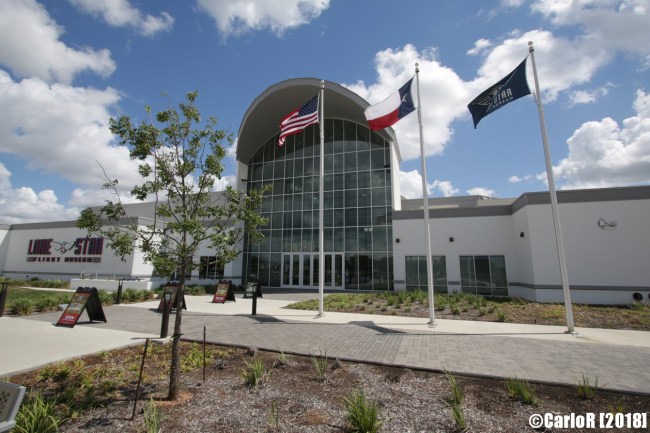
This stunning museum is located on the premises of the Ellington Field Joint Reserve Base. The installation is centered on a collection of mainly airworthy warbirds and classic planes.. It is really top quality, surely among the best displays of the kind in the Nation. Besides that, they offer a well-designed, recently-made, fresh presentation of the history of aviation in Texas, as well as didactic labs explaining the principles of flight through experiments and simulators. You can find their website here.

There are also meeting rooms and galleries for art exhibitions. Really a place to be for enthusiasts of ‘flying oldies’!

The collection is not huge, but it boasts a good number of notable aircraft still flying today. In the first hangar you can find many iconic designs from the Thirties and Forties. There are a North American T-6 Texan and two beautiful Stearman PT-17 Kaydet trainers. 

A centerpiece of the collection is an extraordinary Republic P-47 Thunderbolt – the fastest propeller driven aircraft ever – in a majestic colorway from WWII years.

At the center of the hangar, much room is taken by an airworthy example of the mighty Boeing B-17 Flying Fortress. Together with a few other models, this formed the backbone of the US bombing capacity during WWII. Stunningly restored, this aircraft can be booked for pleasure flights!

Further aircraft on display in this hangar are a Piper L-4H, its civil counterpart, the J-3 Cub, and a similarly looking Stinson OY-1 Sentinel in military colors. 

A true rarity is a stylish Beechcraft D-17 ‘Staggerwing’. This aircraft was conceived in the Thirties as one of the first ‘executive aircraft’, with good handling capabilities, and nice interiors to provide good comfort on board. Despite all efforts, visibility from the front windscreen is probably not very good…

A Grumman F-6F Hellcat, an authentic warbird from WWII, painted in the colors of the Navy, a Fairchild trainer and an ubiquitous general aviation Beechcraft Baron complete the exhibition in the first hangar.

The second hangar hosts both prop-driven and jet-driven aircraft, most of them airworthy or otherwise being restored. The most classic designs in this room are a North American B-25 Mitchell medium-range bomber, a Douglas DC-3, a Douglas SBD Dauntless and a Grumman TBM Avenger.

Interestingly, the Mitchell is the only in the world painted in the colors of the Doolittle Raiders. This very aircraft did not see action during WWII, but later being flown by the CIA on covert missions, it was involved in JFK’s failed attempt to invade Cuba, overflying the Bay of Pigs in the days of operations.

The DC-3 flew extensively with American Airlines and later TransTexas Airways – later to be ingested by Continental, hence the livery – and is still airworthy today. Both the SBD and TBM on display are from WWII days, and are still flying today after restoration work.

While possibly disappearing in front of its illustrious colleagues in this hangar, an honest Cessna T-41 Mescalero represents here the training branch of the armed forces. This is basically the military version of the C-172, probably the aircraft manufactured in the highest numbers in history, and a platform where pilots of all sorts spend part of their training still today. The colors are very nice, and this aircraft is the cheapest you can rent for a ride at the Lone Star Flight Museum.

In the same hangar you can find also (slightly) more modern aircraft. There are three jet-powered aircraft from the early Cold War period. One is a Lockheed T-33A trainer, a very successful aircraft sold in high numbers in the late Forties. More impressing is an authentic Soviet MiG-15, which spent its years in service with the Chinese Air Force and saw action in Korea, opposing the F-86A in the first jet vs. jet campaign in history.

A Polish-built MiG-17 in an incredible ‘Red Banner’ celebration colorway completes the trio.

Close to the exit you can find a beautifully restored Douglas A-1D Skyraider. This aircraft is airworthy, and is an authentic veteran of both the Korean and Vietnam war, where it reportedly sustained extensive damage but was not shot down.

There are also a Sikorsky helicopter used for commuting to oil platforms off the coast of Texas, and a Cobra attack helicopter.

Outside, as a gate guardian on one of the access roads leading to the base, you can spot a NASA Boeing 707 used for zero-gravity flights on behalf of Johnson Space Center.
USS Lexington, Corpus Christi, TX

‘Lady Lex’ – as it was affectionately called by its crews along its illustrious career – is an Essex class WWII aircraft carrier, and with 40 years of active service is by far the one that enjoyed the longest service life. Since the late Sixties it operated as a training platform, where many pilots of the Navy learned how to perform a carrier landing. 

Today this majestic vessel is permanently moored on the bay of Corpus Christi, where it is home to a fascinating history museum covering her long operational history. The corresponding website is here.

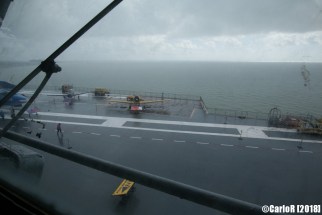
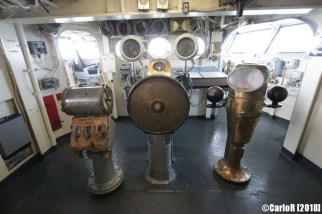
Highlights of the visit are first of all the ship’s bridge, from where you can also profit from a vantage view of the flight deck and of the bay – and of the thunderstorms afflicting the area in mid-August, of course.

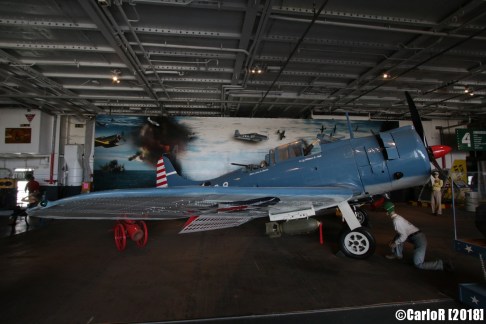
Similarly interesting are the lower deck where aircraft used to be stored. This is huge, and some historic aircraft can be found here as part of a number of small exhibitions.

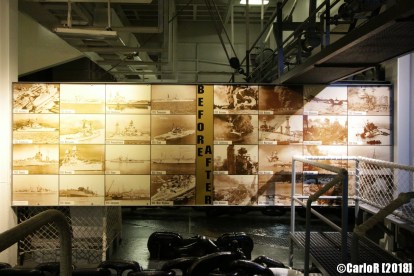
The forward compartments recall the attack of Pearl Harbor in 1941, and display also some artifacts from the time, including pieces of the ill-fated battleship Arizona, and a banner belonging to the older CV-2 Lexington – CV-16 being the number of this vessel in Navy inventory.

An unusual topic is movies – some great scenes of ‘Pearl Harbor’ Hollywood drama starring Ben Affleck and Alec Baldwin were shot on USS Lexington, including an apparently genuine take-off of a B-25 from the flight deck! Other motion pictures partly shot on board Lexington are ‘Midway’ and the series ‘War and remembrance’.

Part of the quarters of high-ranking staff can be visited, including a canteen. These were typically used only when the ship was moored. 

Interestingly, it is possible to walk along the side decks of the ship, where anti-aircraft guns can be found and closely inspected.

Finally, the flight deck hosts a number of aircraft, representing many types in service with the Navy, most of which found their way on the modernized flight deck of this old carrier, during combat assignment or on duty as a training vessel. Being exposed to a salty atmosphere and to the intense sun of the Texan coast, these aircraft have been somewhat coated, which gives them a ‘mock-up appearance’, but this is just an impression, for these aircraft are real and on loan from the National Museum of Naval Aviation.

The aircraft to the stern of the ship are all pretty classic, and represent types which were actually flown from USS Lexington. They include the Douglas TA-4 Skyhawk trainer, the early Cold War Grumman F9F-8T Cougar fighter jet and the loosely similar McDonnell F2H-2 Banshee. This was designed as a fighter, but it was selected to cover primarily the reconnaissance role.

A workhorse which saw combat in Vietnam and all down to the First Gulf War is the Grumman A-6 Intruder, a tactical bomber with good penetration and low-level attack qualities. Differently from the Grumman F-14 Tomcat nearby to the bow of the ship, the Intruder could be operated from the relatively small deck USS Lexington.

The Vought A-7 Corsair II attack aircraft and the North American T-2C Buckeye trainer both saw action from the deck of the Lady Lex. The Douglas A-3 Skywarrior is possibly the heaviest type to be operated from Navy carriers on a regular basis, and it is here represented by a tanker version in a blue colorway. Also this type was actually operated from the Lexington.