Military Collections in Sweden – Fourth Chapter

The geographical location of Sweden on the map of Europe naturally put it on the front line of the Cold War. With a very long shoreline taking most of the northern border of the narrow waters of the Baltic Sea, since jets made their appearance on the stage of military strategy, this Scandinavian kingdom found itself just minutes away from the Soviet Union (which at that time engulfed also today’s Estonia, Latvia and Lithuania), as well as from Communist-led Poland (see for instance this post) and German Democratic Republic (much covered on this website, see for example here).

Keeping up with a long-established tradition of neutrality, dating from soon after the age of the Napoleonic Wars in the early 19th century, during WWII and, afterwards, with the beginning of the Cold War, Sweden managed to stay out of any major explicit alliance with the Western Nations. During the Cold War, by continuing this non-aggressive policy, Sweden was a relevant contributor to the overall stability in the Northern European region.

Considering the early accession of Norway and Denmark to NATO to the West of this sector, in the momentous years following WWII when the USSR was still ruled by Stalin, who had just aggressively sealed the fate of the newly-conquered dominions in Eastern Europe, the independence of Finland, sharing a long, militarily untenable land border to the East with the Soviet Union, was particularly precarious (see Hanko, in this chapter). While leaning towards the West and being historically adverse to Russia, Sweden carefully avoided entering NATO, while still establishing commercial links notably with the UK and France for military supply. This attitude, and the increased geographical distance between NATO and the USSR, likely helped to dilute tension between the two opposing blocs in the area – which nonetheless peaked at some points in history before the demise of the USSR – thus mitigating the chance of an outbreak of hostilities, despite a massive military presence on both sides.

Concerning the military budget however, the neutral policy of Sweden did not by any means entail renouncing to self-defense. A solid economy with natural resources and a well-established tradition in mechanical industry and warfare supply, Sweden was perfectly conscious of the need to sustain its geopolitical role with a credible military power, such to deter as much as possible an aggressor, and ensure survival in case of an open war, even in the high-technology war scenario developing in the post-WWII years. Spared the devastation brought about by WWII, Sweden’s strategy planners and industry started in earnest developing especially ground and air forces.

The development of the air force and the air defense system was carried out in an integrated fashion, within the STRIL (Stridsledning och Luftbevakning, which might be translated into Combat control and Air surveillance) programs. Updated over the years (notably the first being the embryonic STRIL 40, followed by -50, -60 and -80, corresponding roughly to those decades in the 20th century), this program embodied the need for monitoring and self-defense. Considering in particular threats coming from the air, airspace monitoring and related information gathering/processing were carried out through a purpose-designed network of stations and command centers. Having ascertained the type of threat, the Air Force would deploy a proportional countermeasure, accounting for its plans for self-defense. This could be carrying out an intercept by scrambling aircraft – something which happened regularly for the decades of the Cold War, following violations by the Warsaw Pact forces – or, in case of an open aggression, for example deploying SAMs to down attacking aircraft.

The evolution of the STRIL program over the years reflects the development in the technology of the threats, and of the defense system itself. This passed from being based on optical detection and early jets, brought to an intercept point with purely verbal communication, to several types of radars linked directly to situation rooms, and purpose designed aircraft, which starting from the SAAB J35 Draken in the 1960s could receive data of an aggressor via datalink.

After the end of the Cold War and the collapse of the USSR, changes in the geopolitical scenario meant the partial scale-down of the Armed Forces, yet also the update of the still existing Sweden’s surveillance system based on more modern technology. Notably, Russian scouting operations and temporary violations of the air space of Sweden have continued over the years, thus giving a practical reason for maintaining a minimum level of alert.

As shown in previous chapters on this site (see here, here and here), retracing the fascinating history of the Armed Forces of Sweden through visits to dedicated museums, collections and surviving sites, especially the Cold War decades did leave behind some traces, which are still there to be seen.

In this chapter, two sites with many links to the history of STRIL can be found. One is a perfectly preserved installation, a node in the airspace monitoring network in Åstorp, close to Helsingborg. The other is the exceptional technical collection of the Missile Museum in Arboga, run by former staff of the Armed Forces of Sweden and passionate technicians, and preserving in a lively and rich exhibition countless items retracing the history of military missiles, as well as many aspects of air defense, especially in Sweden over the Cold War years.

Photographs have been taken from both sites during visits in the summer of 2025.

Navigate this post – Click on links to scroll

Sights

STRIL Sector Operation Center (SOC), Åstorp

On the origin of the STRIL system – Brief historical note

The STRIL system, an acronym standing for Stridsledning och Luftbevakning, which might be translated into Combat control and Air surveillance, was first systematized in 1948, following the preliminary program STRIL 40, with its roots in the experience gained and in the technology of WWII. A key component of it was the availability of air surveillance stations, physically built as soft manned tower constructions, where staff of the Optical Air Guard, typically voluntary women, kept the airspace under watch (similar to the Royal Observation Corps in Britain, see this chapter). Before 1948, information from these visual intelligence gathering points traveled to a number of decision centers (Jaktcentral, precursors of the Sector Operation Centers) by wire, where additional staff of the Guard managed to create an overall picture of the situation and threats, and military officers could eventually authorize a reaction, typically scrambling aircraft for an intercept, in case of an airspace violation.

With the quick and dramatic evolution of military technology in the first years of the Cold War, the STRIL 50 system, started in 1948 and fully implemented by the mid-1950s, inherited, developed and structured the existing network. The territory of Sweden was divided in 21 sectors, which were covered by optical information gathering points, in the form of 1’300 Air Surveillance Stations (Luftbevakningsstation, or LS in short), i.e. towers like in the previous system, manned by the same Optical Air Guard, which however was now under the control of the Air Force. Arranged in a hub-and-spokes fashion, these stations reported to Sector Operation Centers (or SOC, Luftförsvars Gruppcentral, or LGC), of which 50 existed over the national territory. Finally, the command and control (C2) centers were 11 so-called Air Operation Centers (Luftförsvarscentral, or LFC), where the military staff could authorize and coordinate a counteraction against a threat.

Radar systems, both range-finding and altitude-finding, were a major technological addition of STRIL 50. Initially imported in the form of light or movable systems with moderate capacity, a constant investment in this technology brought to Sweden premium British (Marconi, Decca), Italian (Selenia) and later US (ITT-Gilfillan) technology. Radar information was a mainstay of the STRIL 60 program, largely integrating usual optical LS towers, thus strongly increasing the coverage and range of the pre-existing monitoring system. The level of automation increased steadily over the 1960s and 1970s, merging range, altitude, speed and direction information of a potential threat, and presenting them on a digital plotter to human controllers, directly in the LFC C2 centers. At the beginning of the 1960s, datalink parameter transmission allowed controllers in the LFC to provide flight data of an aggressor to the cockpit of the J35 Draken, avoiding easily detectable verbal communication, for an increased level of effectiveness.

In this constantly evolving technological scenario, the implementation of the OPUS system allowed to still profit from the pre-existing LS and local LGC centers. Within that system, the human operators where supplied with a threat labeling system, allowing them to digitally communicate data of whatever optically detected air traffic, including position and direction. This was automatically collected and filtered in purpose-implemented electronics within the LGC, visualized on a local plot, and forwarded after filtering to the LFC, thus integrating the automatically-processed radar information available to the C2 centers. Perceived also as a safety layer in case of an attack to the inherently vulnerable radar stations, the Optical Air Guard stayed until after the end of the USSR, finally disbanding in 1994.

A visit of the site

What you see in Åstorp is an original, perfectly preserved Sector Operation Center, i.e. an LGC, which stands as an ideal specimen to understand the structure and technology of this element in the defense network implemented through STRIL.

The Center is in a bunker built underground in the rock (as typical to the early Cold War era, see this chapter), and is accessible via a steep and narrow flight of stairs from an unassuming, deceptive wooden hut. Once to the bottom, the structure is all at the same floor level.

A technical room is accessible besides the entrance, with a power generator and electric cabinets for managing power supply in the bunker. The major components in the system, still working, are made by Hägglunds, a major mechanical brand in Sweden (also making the highly successful Bandvagn 206 tracked trailer vehicle, still in use today).

Then you get access to the main hall of the bunker, with a somewhat informal appearance, dominated by armchairs and low tables, and with a kitchenette in a corner. Everything is original and clearly dating from the Cold War era in terms of style.

From this gathering and relaxation point in the bunker, it is possible to reach immediately four relevant functional rooms. The first, and likely the most distinctive, is the situation room, which is visible also from the hall through a large transparent glass window.

To the far end from the entrance is an elevated console desk, with signal receivers, telephones and keyboards.

The room is basically built around a tactical table, with a map of the area pertaining to the SOC, where the information gathered by the LS reporting to this station could be represented graphically. The table you see is possibly the only reconstructed part of the bunker. Over the years, with the technological developments described above taking place (especially in STRIL 60), this table was updated with some degree of automation in the representation of information. The original piece in place when the bunker was decommissioned was taken away at some point, and a careful reconstruction of an analog table has been employed to give a lively idea of the appearance of the situation room in a time when information was managed manually. Furthermore, a regional map and a situation board are visible close to the entrance.

The location was manned by staff of the Optical Air Guard, traditionally women since the WWII era. These were regimented non-military voluntary staff, whereas the commanding officer of the center was from the military. He usually stayed in a second room reachable from the bunker hall, and overseeing the situation room through a smaller glass window.

In that room, his desk has been preserved in a mint condition, with a typewriter, and even military kits with pens and pencils. Close by is a more recent computer console, with a cryptography device.

A very interesting component of the visit is a number of original manuals and publications scattered around the bunker. Among them are aircraft recognition manuals, reporting the silhouette of known aircraft from all nations, and the corresponding relevant performance. These original manuals offer an interesting cutaway of the air force arsenals on both sides of the Iron Curtain, and their evolution over the years.

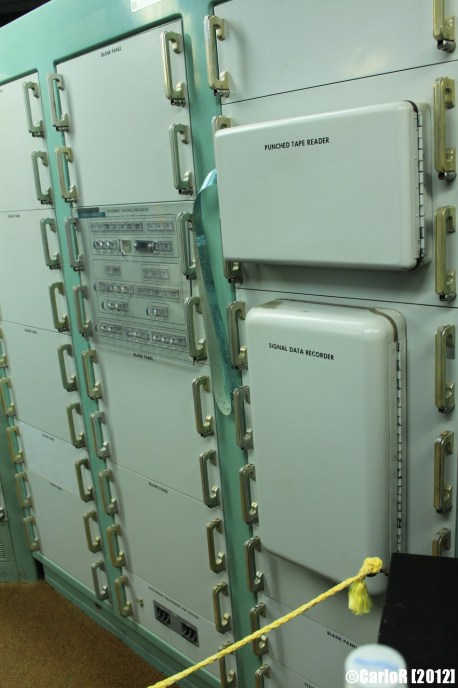
Another core technical room reachable from the hall is dedicated to signal gathering and management. The appearance here is mostly from the higher-technology phases of STRIL 60 and the OPUS system. Among the most distinctive features are the cabinets with the electronic boards from the era, which allowed for the management of the data coming from the peripheral station of the network, including for filtering, visualization on the situation table, and forwarding to the LFC.

The original devices once employed by staff on top of the LS towers are on display here – two portable consoles, one for vocal communication, and another special console for allowing the controller to specify data of the observation target, including its course. The original battery pack is still in place, with labeling from the time.

Interestingly, some of the older optical gear is actually from Hitler’s Germany, marked with the Eagle of the Third Reich.

Vocal communication lines allowed inbound traffic, as well as broadcasting capability, which could be directed also to the local population in case of an incoming attack, also employing recorded messages.

The fourth technical room accessible from the hall is was for air pumping and filtering. Despite not intended for survival of a numerous staff over a long time span, the bunker had an air filtering capability, as typical from the WWII and early Cold War era, when the bunker was built. Today, this system helps in keeping the place ventilated and fighting humidity. Manual pumps from the time are in place, as well as original spare parts, from governmental supply.

Finally, a small sleeping room, reportedly seldom employed for the task, can be found with original berths.

Getting there and visiting

The site is not open to the public, and credit for allowing me and a friend of mine on this exceptional visit goes to the current manager of the place, Mr. Anders Sundberg, and to Mr. Erik Mårtensson, retired officer of the Armed Forces of Sweden, who arranged this visit. It is possible to visit the place by prior appointment only. Contact sightraider.com to establish contact with Mr. Sundberg, who speaks English and has a detailed knowledge of this site as well as of the entire defense system of Sweden since its origin. A visit is therefore warmly recommended for a first-hand experience of an original site within the defense network, and for learning about it from its knowledgeable manager.

Missile Museum, Arboga

The Arboga Robotmuseum, mostly dedicated to missiles, engines and air defense systems of Sweden, can be found in the town of Arboga, roughly 90 miles west of Stockholm.

The town has a long tradition in warfare development, an heritage which is still lively represented by the presence of the Armed Forces and of companies operating in the field of intelligence and warfare systems, including a branch of SAAB. Their quarters are to the south of the town, where an old airbase can be found, with a one-of-a-kind bunker in the side of a local hill, dating from the 1940s. Today employed as a warehouse and barely visible from the northern fence of the airport, this bunker-hangar was designed for missile-related study and development, witnessing a significant commitment of the Swedish government towards that field of research, and towards the town Arboga as a strategic location, already back in a time when rocketry was in its infancy.

The museum is geographically close to the city center. Besides being supported by the Government within the official network of museums dedicated to the heritage of the Armed Forces in Sweden, it is run by a dedicated group of enthusiasts, mostly former military staff or knowledgeable technicians, which give an especially lively atmosphere to the place.

The display starts with a collection of items retracing the history of rocketry in Sweden. Curiously enough, a rare original V-1 from Hitler’s Germany dominates the display by the entrance! Similar to other locations in northern Poland and the Danish island of Bornholm (see here), territories geographically north of the Third Reich’s experimental laboratory of Peenemunde (see this chapter), and within range of the V-1 and V-2 early self-piloted flying weapons, were crash-landing places for experimental flights gone out of control. Southern Sweden was no exception. Moreover, the one you can see in Arboga is the only well-preserved V-1 landed in Sweden. The good state of conservation is evident looking at the fuselage and engine casing.

Even the onboard systems are almost perfectly in shape, including the knob to set the target distance covered by the flying bomb (measured approximately, by recording the rotations of the small ram propeller to the front). Also the actuators for the movable tail surfaces can be seen. They were fed from two tanks of compressed air, one of them, sectioned, revealing the fabric-inspired construction.

Most interestingly, the pulse-jet core, with the injection pipes and the radially oriented valve system, is also displayed.

For many nations including Sweden, the analysis of the – for the time – very advanced aeronautical projects of the Third Reich constituted a valuable starting point for their own development programs in the field. The topic is relevant to the museum in Arboga, where many early designs of autonomous flying platforms developed in Sweden are represented. Notably, an early project from the Navy, the RB310 on display, from soon after WWII, was pushed by the the same motor type as the German V-1 (note the distinctive side inlets).

Yet until the late 1950s the pulse-jet concept lived on with the RB315 ‘Agaton’, where the air breathing component of a developed version of a pulse-jet (the SM11, not dissimilar at a glance from the original German design) can be seen emerging on the fuselage.

Still air-breathing yet based on small turbojets, two interesting designs from the same era are on display. One is the compact long-range anti-shipping RB15F, developed for the SAAB AJ37 Viggen, and employed as well with the JAS39 Gripen. The other is the target drone developed by Beechcraft in the US as MQM-107, and in service in Sweden as the RB06. Its own small French-made TRI 60 turbojet can be seen below the the aircraft.

Perhaps the most massive among those on display is the ship-mounted version of the RB08A. This design was operationally employed within the Navy (see here), and later for coastal defense employing land-based batteries. It was pushed by a small turbojet by the French company Turbomeca. This heavy radar-homing anti-shipping missile is displayed with some of its 1960s-fashion internal systems dismounted.

A full array of missiles employed by Sweden’s Armed Forces yet originally designed in NATO Countries is on display, along with a number of prototypes and models originally from Sweden.

A less-known chapter well covered here is that of special under-wing pods. For example, the BOY401 flare dispenser for the Gripen reveals a massive sized and non-trivial construction, when checked from a close distance. Even more complex is the BOX3 pod, originally designed in the 1960s for the SAAB J32 Lansen as a decoy dispenser for detection jamming, with provision for flare and even a nose-mounted radar.

Active jammers are represented for example by the Apparat 27 and the U22 capsule, on display side by side, ahead of the fuselage piece and engine from a SAAB J37 Viggen.

A second area of the museum is dedicated to diverse smaller-scale ground-launcher missiles, as well as drones. For example, the very successful RB53 Bantam and RB56 ground-launched anti-tank missiles are on display, with the corresponding aiming device and computer. The bigger RBS17, the Swedish version of the AGM-114 Hellfire, has been placed side by side with others, allowing for a direct size comparison. It is in service with the coastal defense artillery.

An interesting cutaway is offered for the case of the RBS90 surface-to-air missile, revealing the complexity within the casing of this type of weapon. Nearby are two unmanned flying platforms employed by Sweden’s Armed Forces, the French-imported UAV01 and the lighter Swedish design of the UAV02 with its own control console. Sweden employed a SAM systems for protection of strategic sites, like airbases. Notably, the massive British-design Bloodhound missile was employed (one can be seen outside the museum). A detailed scale reproduction of a a SAM battery cand be found here as well.

Cameras, flash lights, pods employed for PHOTINT/SIGINT, and a radar head from the nose cone of a J37 Viggen attack aircraft are on display as well.

Notably, some of the gentlemen behind this collection were deeply involved in the airspace monitoring and defense activities of Sweden (see also the previous site on this page) during their military careers. Their experience with the STRIL initiatives is a fundamental knowledge base in this respect, and a chat with them is warmly suggested for everybody with an interest in this chapter of warfare history. Some of the radar consoles to be found in the top-level nodes of the air defense network (LFC), where all data from peripheral nodes were assembled to represent the detailed situation of the air space, are on display in the collection. They allow the visitor to retrace the technical evolution of the radar technology for air defence.

Notably, since the arrival of the SAAB J35 Draken, it was possible to send the data of an intruder to the panel of the aircraft via datalink from the console of the radar system (in particular the Decca PS-08 radar, of which four covered the exposed territory of Sweden, was an enabler in getting sufficiently accurate data). The console is on display together with the panel of the Draken. A supersonic single-pilot aircraft with exceptional performance, that aircraft was not easy to pilot with a fully analog cockpit. The addition of information on another aircraft, theoretically very effective for managing an intercept, in an operative scenario required a very high skill and preparation by the pilot, to face a very high workload.

The general amelioration of electronics over the years allowed to develop these systems, in conjunction with the appearance on the scene of the SAAB J37 Viggen and later the JAS39 Gripen, greatly reducing the workload of the pilot by displaying target information on scopes or maps, making them more promptly usable.

A mainstay of the defense system, radar consoles allowed controllers to keep the entire airspace of Sweden under watch. During the Cold War, the range of these systems allowed to scan well south of Berlin and within the USSR. However, the vantage geographical position of Sweden on the boundary of the Eastern Bloc put this Nation at risk of intrusion. For safety, in the mutual mistrust among opponents typical to the Cold War, camera recorders were employed since the 1960s to keep trace of radar blips, also to the aim of proofing intrusions or violations. The special camera arrangement on top of a radar scope is on display as well.

These recordings are now a valuable and interesting trace from the past, witnessing momentous events like the withdrawal of Soviet forces following the 1968 Soviet invasion of Czechoslovakia and the (sad) conclusion of the crisis, large exercises of the Warsaw Pact forces over the Baltic, or little-known, evident intrusions of Soviet aircraft over Swedish territory, and even the overflight by a USAF Lockheed SR-71, at its typical, extremely speed. This incredible material, visible in the museum in the form of a cyclically-running documentary, can be purchased as well after visiting.

A big component of the museum is dedicated to a large and neat collection of aircraft engines. The aircraft design program of Sweden, based on the SAAB designs from the late 1940s until the end of the Cold War, was supported by jet engines modified mostly by Volvo, starting from British or American designs.

The presentation in the museum allows to learn much about the specific features of many of these aircraft engines, by displaying cutouts, technical drawings, as  well as components of the ancillary systems and utilities (pumps, generators, etc.). Interestingly, a poster-size reproduction of an old picture portrays the local bunker hangar in Arboga (see above).

An interesting display of cockpit panels from Swedish aircraft allows for an analysis of the evolution of their design. An old flight simulator for training purposes, the ubiquitous US-designed Link Trainer, was apparently employed also in Sweden.

Finally, another exceptional feature of this museum is the availability of two simulators of the SAAB Draken and Viggen! These have been prepared making use of sections of their respective fuselages, notably including the cockpit. They make for an unmissable experience for everybody, especially if you already have some piloting experience – in that case, you may have chance to fly one of these two iconic attack aircraft from the Cold War with incredible realism, for example on an intercept mission versus a Soviet cargo, guided by the expert words of an authentic radar controller!

Getting there and visiting

This one-of-a-kind museum on a very interesting and special topic makes for a must-see destination for everybody with an interest in the Cold War. The exact address of the museum is Glasbruksgatan 1, 73231 Arboga. The location has a large parking ahead of the entrance. The premises taken by the collection, on the ground floor of an old industrial building, are compact and easy to tour. Yet the collection is very rich, and a visit interacting with the group of friendly volunteers (some of them speaking English fluently) running the site might easily take  2 hours or more for an interested subject.

Additionally, an experience on the flight simulator is definitely worth a visit on its own. This can be arranged by prior email or call, and combined with the visit. The professional website, with full information on the museum and exhibits in multiple languages, can be found here.

My own exceptional experience on this site together with a friend of mine, which included memorable flights in both Draken and Gripen simulators, was kindly sponsored and arranged jointly by the Volunteers of the Arboga Robotomuseum, in particular Mr. Antero Timofejeff, and by Mr. Erik Mårtensson, both former officers of Sweden’s Armed Forces. To these gentlemen and to the Volunteers go my personal thanks and congratulations!

The Estonian Aviation Museum

A nice and lively university town in the heart of the Estonian countryside, Tartu has really something for every kind of tourist – including those interested in aviation history. The Estonian Aviation Museum, or ‘Eeesti Lennundusmuuseum’ as they write it in the tricky local idiom, boasts a substantial and heterogenous collection of aircraft preserved in exceptionally good condition, which will not leave indifferent even the most knowledgeable aviation expert.

Having being for long a socialist republic in the realm of the Soviet Union – and today sharing a border with Russia – Estonia had access to massive surplus reserves after the end of the Cold War, so it is no surprise that Soviet aircraft are well represented in an Estonian museum. This already might appeal to western tourists, for the exotic, menacing silhouettes of MiGs and Sukhois are not often to be found except in less accessible spots in the former Eastern Bloc. Yet some more unexpected and rare models have been added over the years, including some SAAB aircraft from Sweden which are authentic collectibles.

The following photographs cover almost every plane that was there in summer 2017.

Sights

Most part of the collection has been preserved in a cleverly designed structure, made of small open-walled hangars with translucent canopies. The aircraft are illuminated by natural light, helping much when taking pictures, but they are not exposed to direct sunlight, rain or snow, which tend to damage both metal and plexiglas on the long run. Furthermore, the lack of doors and frames allows you to move around freely, and the place is not suffocating nor excessively warm.

The aircraft are basically all from the Cold War era, but some of them have outlived the end of the USSR and were retired more recently. The portraits are grouped here roughly based on the nationality of the manufacturers or aircraft mission.

Designs from the US

The American production is represented in this museum firstly by a McDonnell Douglas F-4 Phantom II, operated by the West-German Luftwaffe. The General Electric J79 turbojets have been taken out of the airframe, so you can see them separately.

A pretty unusual sight, also the antenna and electronic group in the nose cone have been taken out and are on display. This Phantom is a F-4F, a version specifically developed for West Germany from the basic F-4E. The former inventory number was 99+91.

Another iconic model on the menu is a Lockheed F-104 Starfighter, formerly from the Italian Air Force. This exemplar is actually an Italian-built ‘S’ version, and among the latest to be retired by the Aeronautica Militare. The engine, again a J79, is on display elsewhere in the museum. An unusual crowd of instruction and warning stencils populate the external surface of the aircraft.

Soviet Military Models

The majority of the aircraft on display were designed in the Soviet Union or other countries of the Warsaw Pact.

Two aggressive aircraft include a MiG-21 and a MiG-23. The first, present here in the colors of the Polish Air Force, is a MiG-21bis Fishbed, the latest development of this fast delta-wing fighter/light-interceptor.

Possibly one of the most ubiquitous fighters of the jet age, the MiG-23 Flogger is part also of this collection. The aircraft you see in the pictures is a MLD variant, representing the last upgrade of this iconic fighter, which was also the basis for the very successful MiG-27 design.

It bears the markings of the Ukrainian Air Force, therefore it is likely an ex-USSR aircraft. The engine is sitting besides the aircraft, and two rocket canisters are placed beneath the fuselage, close to the ventral GSh-23 twin-barreled cannon.

A less usual sight is a MiG-25 Foxbat, a super fast interceptor/recce aircraft. Conceived in the late Fifties when the race for speed was in full swing, it was developed into a high performance platform to counteract the threat of the SR-71 Blackbird. It was built around two massive Tumansky R-15 afterburning turbojets, rated at a pretty high wet thrust of 110 kN, resulting in an incredible top speed around Mach 3.2! The aircraft is pretty sizable, and you can appreciate that looking at the picture of the main landing gear – search for the cover of my Canon wide lens close to the ground and compare sizes!

The menacing silhouette of this huge bird, with red stars on the vertical fins and a bare metal fuselage, will likely make relive in you an ‘Iron Curtain feeling’!

One which will not go unnoticed is a Polish Air Force Sukhoi Su-22M4 Fitter in a flamboyant, very colored livery. This massive fighter-bomber represents the export version of the Su-17M4 built by the USSR for domestic orders.

Despite the shape, roughly similar to that of the MiG-21 also on display, the size of this aircraft is much bigger – you might think of Su-22 as a case for a MiG-21…

Soviet bombers are represented by a pretty rare Sukhoi Su-24 Fencer, which is today still in service in Russia. The example on display bears the markings of the Ukrainian Air Force, meaning it was once a Soviet aircraft.

This massive twin-engined beast outsizes all other military aircraft on display. The aircraft is on display with three support tanks under the fuselage and the inner wing pylons.

A less common sight is a Yakovlev Ya-28P Firebar, a long-range intercept version of this multi-role platform from the early Sixties. This design is very interesting, with a four-points undercarriage and a very long nose cone, where a radar system for a target-tracking and missile guidance system was located. The two turbojet engines are mounted in cigar-shaped underwing pods. The relevant sweep of the wing suggests a significant speed capability, yet many variants of this aircraft were developed to exploit also its good range performance. The antenna originally placed in the nose cone is on display besides the aircraft, which bears original Soviet markings.

Soviet Transport Aircraft

Two aircraft which could not find their way in covered shelters mainly due to their bigger size, are a Tupolev Tu-134A-3 and a Yakovlev Ya-40. Both can be accessed, so you can get a view of the inside, including the cockpits.

The Tu-134 twin jet, with its distinctive glass bulge in the nose ahead of the cockpit, has been for long a ubiquitous aircraft in the USSR and in many countries of the Eastern Bloc. The exemplar on display was taken over by the Estonian company Elk Airways, created after Estonia left the USSR.

Notwithstanding this, the aircraft betrays its Soviet ancestry and ownership in every particular, from the all-Cyrillic writings to the hammers and sickles here and there, from the design of interiors to the exotic cockpit, painted in a typical lurid Soviet green and with prominent unframed black rubber fans for ventilation.

The Yak-40 is an interesting three-jet executive/small transport aircraft. The one on display went on flying for at least some good 15 years after the collapse of the wall in Berlin.

The internal configuration features an executive room ahead of a more usual passenger section and tail galley. The style of the cabin and of the pure analog cockpit is really outdated for todays standards!

A rugged workhorse still flying today in many countries is the Antonov An-2, a single propeller, radial-engined, biplane tail-dragger transport. There are two of them in the collection. One is under a shelter and can be boarded. The interiors are very basic, but the visibility from the cockpit is very good especially for a tail-dragger with an engine on the nose.

Swedish Aircraft

An unusual chapter in air museums except in Sweden is that of SAAB aircraft, which are represented in this collection by two iconic models, a Draken and a Viggen, and an extremely rare, very elegant Lansen. All are in the colors of the Royal Swedish Air Force.

The Saab 35 Draken features a very distinctive double-delta wing, and was developed in the Fifties for reaching a high supersonic speed. The design turned out to be pretty successful, and was operationally adopted primarily as a fighter by Sweden and other European countries as well.

The one in the collection is painted in a bright yellow livery. The infra-red pod under the nose cone of this aggressive attack aircraft looks like the lidless eye of an alien!

The Viggen is a an attack aircraft from the late Sixties, developed for the domestic military needs into some sub-variants. With the JA 37 version displayed here, the Viggen went on to constitute the backbone of the intercept fleet of neutral Sweden, and was retired only in the early 2000s. The aerodynamic configuration features a prominent canard wing, and the Viggen was notably the first in such configuration produced in significant numbers.

The most unusual of all three SAAB designs on display is surely the SAAB 32 Lansen. A very neat design from the Fifties, loosely recalling the Lockheed P-80 and the Hawker Hunter, the Lansen was a jet fighter of the early Cold War developed specifically for Sweden and gaining a good success. The ‘E’ version on display was converted from the original fighter variant (‘B’) for the ECM role, and kept flying almost until the end of the 20th century. The green painting of the Royal Swedish Air Force is really stylish, definitely adding to an already elegant design.

Soviet Surface-to-Air Missiles (SAM)

Curiously enough, an extensive collection of SAMs is part of this rich collection. All major missiles from SA-2 to SA-6 are represented, some of them in multiple exemplars. The size of these missiles, especially the oldest, is really striking. They are stored outside, besides some cases for missile transportation, deployable radar antennas, and what appears to be a flak cannon from Hitler’s Germany – a bit of an outsider…

Jet Engines

Many of the engines of the aircraft on display have been taken out of the corresponding airframes and put on display besides the plane where they used to belong, or in a dedicated part of the museum together with others. The J79 belonging to the Italian-built F-104 can be recognized from the Italian plaques on many components.

Many soviet engines bear markings in Cyrillic, and one of them, a larger turbofan which does not fit in any bird on display, has been cut to show all components.

More…

More aircraft in the collection include some Mil and Kamov utility helicopters, a BAe Hawk of the Finnish Air Force and other trainers mainly from countries of the Warsaw Pact, some of them now on the civilian register.

A further notable aircraft is a Dassault Mirage IIIRS from the Swiss Air Force – with multi-language French and German stencils all over.

There are also some anti-aircraft guns, armored vehicles, tanks, and other curios items to whet your appetite!

Getting There and Moving Around

The museum can be reached 10 miles south of central Tartu on road 141, about 15 minutes by car from there. There is a free parking area nearby the entrance. As remarked, the collection is well-kept and somewhat publicized locally. There is a website with all information in English. The time required for visiting may vary from 45 minutes for a quick tour to 2.5 hours for photographers and those with a specific interest in the matter.

Aircraft and Missiles Around Tucson

The dry desert ranges of southern Arizona make for a perfect habitat for warbirds – the almost null humidity percentage and ‘sky clear’ conditions prevailing year round are particularly attractive when it comes to store rust and corrosion-prone pieces of machinery, like aircraft are.

For this reason the region between Phoenix and the border with Mexico is scattered with larger and smaller aircraft-centered businesses, going from pure airplane and engine storages, to refurbishment shops, parts resellers and so on.

Of course, if you own an old aircraft you would like to preserve, it would be a good deal finding a place in the area. This is what some people from the Government must have thought when they placed the famous AMARG in Tucson, in the southernmost part of Arizona. It was likely the same motivation which brought the largest private collection of aircraft in the world – Pima Air & Space Museum – down to the same location.

These two attractions, both perfectly accessible on a regular basis, already make a visit to Tucson a true ‘must’ for aviation-minded people. But the area offers also another unique site surely to be found in the shortlist of every aviation enthusiast – the only inter-continental ballistic missile silo you can visit in the US!

In this chapter you can see a series of photographs I took during a memorable two-days visit to these places back in 2012.

The 309th AMARG at Davis-Monthan AFB – Tucson, AZ

The acronym AMARG stands for ‘Aerospace Maintenance and Regeneration Group’, a group which is operating under the Air Force Materiel Command. The most conspicuous part of their facility at the Air Force Base of Davis-Monthan – also home to the 355th FW – is a huge open-air storage area in the desert. This is made of two parts.

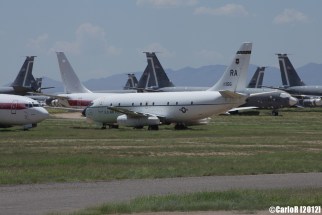
The first is where surplus aircraft from the various branches of the Armed Forces of the US and some of their Allies are stored. Before being placed out on the desert, these aircraft are treated to better preserve them, sealing all doors, windows, holes and slots. Some parts are covered in a special white rubber coating, to protect them from direct sunlight exposure. The process can be inverted, and all aircraft preserved in these conditions can be re-activated and return fully operational.

The aircraft stored here in a mothballed condition are really many and make for an unbelievable sight! You will not find the same amount of planes in the same spot anywhere else in the world! And if you think this is just the ‘not strictly necessary part’ of the Armed Forces, well, it’s hard to imagine what the sight of all the aircraft on duty would be like!

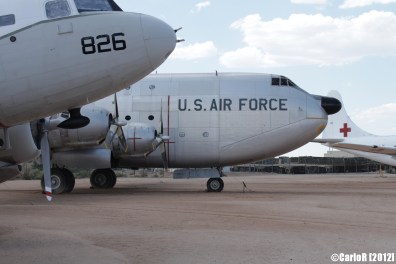
In the same part of the installation there is also a kind of ‘commemoration alley’, where an exemplar for almost every model ever stored on the base have been preserved, so as to keep memory of the past activities of the AMARG. These aircraft are placed to the sides of a straight road in a mothballed condition.

The second main part of the AMARG is known as ‘the boneyard’, and it looks more like a huge scrapyard. Here aircraft which are not intended to ever return to active service are stored. Thanks to the good climate, their condition probably appears more derelict than it actually is. Most aircraft here are used as donors for spare parts to supply others still on duty. The business is not limited to within the national borders. At the time of my visit, there were still many General Dynamics F-111, which until recently had been used to supply spare parts to the Royal Australian Air Force, which had just finished to phase out that model from active service.

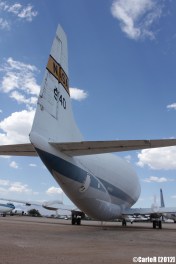
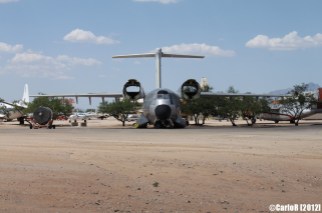
Geographically in the same area of ‘the boneyard’, it is possible to see also some larger aircraft on storage, up in size to the Lockheed C-5 Galaxy, plus some unique exemplars, like the incredible Boeing YAL-1, a modified 747-400 mounting an experimental laser cannon!

There are also some large missiles, and some mystery aircraft with civil markings, as well as a less attractive but really important asset – all the factory rigs necessary for re-booting the production of discontinued plane models.

Other items not on shortage here are jet engines. There are hundreds of them, some stored in dedicated cases, some just placed on a sand lot in open air.

The AMARG is very busy also with maintenance and conversion activities. At the time of my visit, they were working on the conversion of some McDonnell-Douglas F-4 Phantom into target drones for weapons testing.

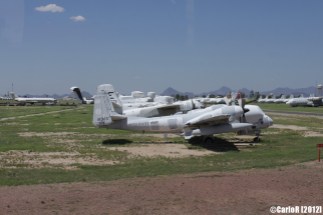
Leaving the installation you can spot close to the fence of the airbase – and besides a parking area for sequestered cars – a small deposit for aircraft. I don’t know much about it, but noticed a pretty good number of interesting items, especially a series of Grumman Albatross.

Visiting

This is an active military installation, and visiting is managed only by the Pima Air & Space Museum through a special agreement with the Air Force. The museum is located at a short distance from Davis-Monthan, just south of downtown Tucson. You will need to go to the museum reception to arrange a visit. Tours are offered on a regular basis, but it is not possible to book tickets, so you will need to go early to make sure you get your tickets. Full info from the website of the tour here.

The visit will take a couple of hours in total. You will board an air conditioned bus and you will tour the AMARG facilities without stepping off, which is nice as the temperature maybe crazy outside. The guide during my visit was a friendly former Super Sabre pilot and war veteran. Taking pictures was allowed at the time of my visit, except when military personnel were in the scope of your camera and in some specific spots your guide told us. A very enjoyable visit to a truly unique place! Totally recommended for aviation enthusiasts.

Pima Air & Space Museum – Tucson, AZ

Besides being the largest privately run collection of aircraft in the world, this museum has adopted a very interesting acquisition policy and also boasts an active restoration facility, making the place interesting not only for plenty of aircraft, but also for their variety and condition of preservation.

The museum is organized with some large hangars, close to the reception and gift shop, a huge open-air part and some smaller hangars scattered over the property.

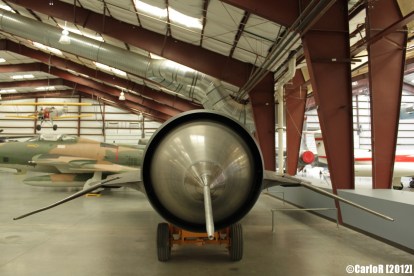
The first hangars showcase some items from the collection which were restored to a very good non-flying condition. These include a very rare Martin PBM-5 Mariner, a Lockheed SR-71 Blackbird, an A-10 Warthog, a F-14 Tomcat and a F-4 Phantom! Also a super rare North American F-107 is part of the collection. Already enough for a visit, these are just a starter…

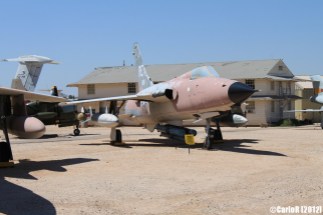
On the outside you will find a representative for virtually any model ever in service with the USAF or the Navy since the Fifties, from fighters to bombers, transport and observation aircraft.

These include a B-47 Stratojet, two B-52 Stratofortress, a B-36 Peacemaker – it looks like a real monster even parked outside, where things look shorter! – and some special aircraft, like a ski-equipped C-130, a veteran of operation ‘Deep Freeze’ to Antarctica, a Super Guppy and the Boeing KC-135 Stratotanker christianed “Weightless Wonder V”, used for parabolic zero-gravity flights.

In a somewhat secluded part of the open-air exhibition you will find a shortlist of extremely rare aircraft, including a Beechcraft 2000 Starship, a twin turboprop design by Burt Rutan with a canard configuration, made for the executive market, and a Budd RB-1 Conestoga, an aircraft proposed during WWII when an aluminium shortage was feared, and mainly made of steel! Both models never entered serial production. Nearby there is also a Boeing YC-14 prototype, which participated in a competition for a STOL aircraft to replace the C-130.

Other highlights on the outside include a Convair B-58 Hustler and a Douglas VC-118 Liftmaster – a version of the Douglas DC-6 propliner – serving as Air Force One transporting Presidents Kennedy and Johnson on some official travels. But the list of interesting aircraft here would be really long!

Some aircraft in the exhibition are pretty rare to find at least in this part of the world. These include a French Sud Aviation Caravelle passenger aircraft, several British aircraft including a Fairey Gannet, and also some Soviet models.

The restoration facility could not be toured during my visit, but on the outside I could spot a rare Avro Shackleton patrol aircraft from the Fleet Air Arm – an unexpected sight in the desert of Arizona!

Among the warbirds preserved in the smaller hangars, a B-17, B-24 and B-29 from WWII are surely worth mentioning. Another interesting sight is one of NASA’s X-15 rocket planes.

You can choose to tour the huge open-air exhibition with special covered trolleys departing at certain times instead of moving around alone. I elected to go on my own, but I experienced a certain level of dehydration – as it is typical in deserts, a combination of intense sunlight, hot air temperature and very low humidity triggers intense perspiration from your skin, but this goes unnoticed to you, for sweat evaporates fast and has not the time to accumulate to form droplets, so you don’t realize anything strange is happening… until your mind starts to feel light and your legs very heavy! Luckily, there is a restaurant offering cold drinks inside the museum – there I consumed the fastest ‘tall size’ of Coke in my life during my visit!

Visiting

The museum is open year round and almost every day. Check the website here for further info. The location is quite close to downtown Tucson, and can be easily reached by car.

To help your plans, if you are an aviation enthusiast consider that the combination of a visit to this museum and the AMARG facility described above will easily fill a 1-day schedule, for this collection is extra-large and also very interesting. This is especially true if you are interested in taking pictures – something you are encouraged to do by the clean, perfect light typical of desert areas.

I visited in August and the temperature was very high. You can bear it easily thanks to the low humidity rate, but be sure to take precautions to avoid dehydration. Visiting in other seasons may be indicated to enjoy milder climatic conditions.

Titan Missile Museum – Sahuarita, AZ

This museum encompasses a full Titan II missile launch facility. The Titan II was constituted by a liquid propelled, two-stages missile capable of reaching targets more than 6000 miles away, transporting a 9 megaton W-53 thermonuclear warhead, the most powerful ever deployed operationally by the US.

There were just above 50 such launch sites in the US, in southern Arizona, Kansas and Arkansas, and this is the only one which can be visited today. The operational life of the missile spanned from the early Sixties to the mid-Eighties. Even though it was soon superseded by the Minuteman missile fleet, the mighty Titan II remains a true icon of the Cold War era.

Being more than 100 ft tall and weighing around 350’000 lb, this missile could not be moved easily, and was in fact kept in a concrete interred silo specifically built around it. The cylinder-shaped silo is a relatively small part of the installation, which is composed also of a number of underground passages, control rooms, staircases, storages, safety doors, air ducts, cables and literally tons of equipment.

The whole site was designed to withstand the blast of a nuclear attack directed to the silo, itself a designated target for the enemy of the time – the Soviet Union. To this aim, a large part of the structures in the underground facility are standing on a complicated elastic base, with springs and dampers to compensate for intense vibrations coming from the ground in case of a nuclear attack.

During your visit to the museum you will receive a briefing about the history of the Titan II in a service house. You will be given a helmet before accessing the underground control part.

The most interesting stop in this area is by the control room of the missile, where the condition of all systems was constantly kept under control. It was from here that the missile could be armed and launched in case an attack was authorized. During the visit you are shown a simulation of the launch sequence. This is a very lively experience, for all control panels are lighted on as they used to be when the system was actually working!

After exploring a bit of the underground site, you reach the inside of the cylindrical silo, where a Titan II is still standing today. Here you can appreciate the monstrous size of this ICBM, and the complexity of the system – many pipes going in and out, cables and other systems.

In the final part of the visit you leave the underground facility and return to the ground level, where you can have a look at some pieces of machinery like dismounted rocket engines, pumps and other equipment connected with the function of the site.

All in all, this museum represents a unique destination for aviation enthusiasts as well as historians, veterans of the Cold War and everybody with a fascination for relics of the duel between the two Superpowers. Even if you are not an expert, you will be astonished by the size and complexity of this missile, so there is definitely something for everybody in this site!

Visiting

The Titan museum is located south of Sahuarita, less than 15 miles south of Tucson, AZ, along the I-19 going to the Mexican border.

The museum is actually a friend of the Pima Air & Space Museum, but it is a separated entity, so timetables are different. Visiting is possible only through guided tours, which are organized on a regular basis. Full information from their website. They also offer special-themed tours to usually inaccessible parts of the site. Taking pictures is possible anywhere, for the installation is today decommissioned and declassified.

Touring the underground facility may ba a little uncomfortable when moving in groups – the rooms where not intended for tourist groups! -, there are several flights of stairs and the terrain is sometimes uneven. That said, for the average person there is really nothing to worry about during the visit.

The Aerospace Valley

Among the most intriguing places for aviation enthusiasts, the ‘Aerospace Valley’ is the name attributed to the flat desert area extending North of the town of Palmdale, which can be reached with an about 70 miles drive north of central LA along N.14.

This large desert basin, which extends further north to Mojave, some 35 miles from Palmdale on N.14, encompasses two installations of major relevance for the history of aeronautics and for todays air power research, namely Edwards AFB and the close-related Plant 42.

The former has been developed for decades basically with aircraft testing in mind, and is located on the dry Rogers Lake. Today it is still an active AFB, home of the 412th Test Wing and other units. It is also operating a NASA research center named after the first ever moon-walker Niels Armstrong. The installation has more than ten runways, some of them paved in sand. Visiting is obviously prohibited – there used to be planned visits, but this appears to be not any more the case today. This site is really huge, and would offer many interesting sights to the enthusiast, including some relics from the past abandoned in the desert far from the main buildings of the base – some buildings and runway have moved over time for convenience and trying to cope with the natural movements of the desert sand, altering the slope and shape of the dry lake basin.

Obviously, the base is constantly guarded, so you may come close to it but you cannot really get close to what is in it without an authorization. In any case, I found exciting just being around where the sound barrier was passed by Chuck Yeager in 1947, and if you like deserts of the westernmost part of the country, touring this area would be interesting just for the natural setting – and even more if you are an aeronautic-minded person.

Plant 42 is actually not a totally separated entity from Edwards AFB. It is a unique installation, where some of the most iconic aircraft factories in the history of US military airpower – Lockheed ‘Skunk Works’ division and Northrop-Grumman – have some of their production and assembly hangars. These are all around the same airport, which is not an airbase – in the sense it’s not home to any units of the USAF – but is nonetheless owned by the Government and leased to the companies operating on it. Today Plant 42 is configured to supply and support test aircraft operated at Edwards AFB.

There is also the NASA Dryden research center installed on the premises of this airport, which is physically located on Plant 42 but is nonetheless administrated by Edwards AFB.

Even though Lockheed moved its Skunk Works division here only after the assembly of all exemplars of the SR-71 well in the Eighties, it was here that during the last decade of the Cold War the Blackbird fleet underwent maintenance. Also the reactivation of the U-2 production line with the TR-1 in the years of the Reagan administration implied production of new aircraft was carried out here.

Other most notable items produced here include the Space Shuttle orbiters – the hangar for their assembly is still standing and can be clearly spotted. Northrop produced here the world-famous F-5, before merging with Grumman. Today Northrop-Grumman, Lockheed and Boeing have active support lines here.

As you see, the area has been a focal point for aeronautics since long, fully justifying the name of ‘Aerospace Valley’.

But it’s not over. There are more sights of the kind around. Mojave has been for long a place for storing aircraft of all sorts and size – a properly sized airport, capable of operating a Boeing 747, obviously being a promptly answered necessity for companies in that business – taking advantage of the dry climate of the Californian desert. Literally tens of large liners of all sorts can be found parked waiting for reactivation, resale or scrap on the apron of Mojave airport. In more recent years, the place has grown to higher fame for being used as a base for space tourism operations. Consequently, the airport has been proudly renamed ‘Mojave Space Port’.

The following photographs from these and other sites in the Aerospace Valley have been taken during a visit in summer 2014.

Navigate this post – Click on links to scroll

Aerospace Valley – View and Hangars

There is a panorama point with a placard approaching Palmdale from N.14. From there you can see Palmdale and reach beyond to Plant 42.

Among the hangars scattered around the area of the airport in Plant 42, it is possible to see the Boeing facilities, with new Boeing liners around. One of Boeing’s hangars has an asymmetric roof. This is where all Space Shuttles were built, the higher part of the roof made to fit the tall tail of the orbiter. The name ‘Northrop-Grumman’ can be seen standing above the airside door of probably the largest hangar of all. Both Boeing and Northrop-Grumman occupy the northern part of the airport.

The emblem of the ‘Skunk Works’ can be spotted on the Lockheed-Martin hangar to the south-west of the complex. Further East the NASA Dryden facilities occupy the south-eastern part of Plant 42.

Skunk Works

In front of the gate of Lockheed ‘Skunk Works’ on Plant 42, at the end of 15th St. E in Palmdale, it’s possible to reach a small park with an F-16A and an F-104N, both Lockheed designs. These exemplars were used for testing by NASA Dryden research center, and are actually on loan from NASA Dryden. The F-16A is the only civil registered aircraft of the type, where the F-104N, one out of three specifically designed for NASA for pilot’s proficiency and for use as chase aircraft, logged more than 4000 hours flying for NASA.

Note: I involuntarily triggered a security inspection having ventured by car on the road running along the Lockheed hangar nearby the gate – the road is called Lockheed way. This is probably because the road is private property of Lockheed – even though it runs along the outer side of the fence. I was spotted and reached by pickups of Lockheed security – nothing bad, but better avoiding this if you can. The hangar with the Skunk Works emblem can be photographed from a little further, near the railway track to the west of the airport.

NASA Dryden

Two sights attracted my attention on the apron of Plant 42. Both could be clearly spotted from 40th St. E in Palmdale, running along the eastern side of the plant. Placidly parked on the apron where NASA Douglas DC-8 – as far as I know the only one still operated by NASA, which is using it for satellite testing, new sensor testing, space vehicle telemetry and atmospheric studies – and the massive Space Shuttle Carrier N911NA. Today the latter is on permanent display in Palmdale, the photos were taken before it was prepared for display. This is one of only two Boeing 747 converted for transporting the orbiter, the other (N905NA) being in Houston.

The DC-8 is being operated by NASA Armstrong research center, from the ‘neighbor’ airbase of Edwards, but I found it at NASA Dryden.

Note: photographs of what is on the apron of Plant 42 from the distance are virtually impossible during the day due to excessive thermal turbulence close to the ground. Consider going near sunset for avoiding such annoying effect.

Blackbird Airpark

This spectacular exhibition can be easily reached driving on E Ave. P, to the South of Plant 42, Palmdale (website here). It can be clearly spotted from the road. The most peculiar display is to the front of the small museum building, and is composed of three Lockheed ‘black’ aircraft, namely an A-12, an SR-71 and a U-2. Also there are a D-21, a ramjet propelled drone mounted on a modified A-12, the engines of both the A-12 and SR-71 and of the U-2, and two different spooling mechanisms for starting up the engines of the A-12 and SR-71.

This is the only place on Earth where an A-12 and a SR-71 can be spotted together.

Close to the door of the museum building there are models of the A-12, probably built for wind tunnel testing. Inside the building, first and foremost you can find some air conditioning… there are also artifacts, videos and a nice shop with books and items about Plant 42 and the three ‘black’ aircraft outside. I personally met Bill Flanagan, who collaborates in managing the airpark on a regular basis, and is a former RSO on the SR-71 – he was very nice and told me many interesting stories about the aircraft outside on the apron. Some of the vids you can see there (they are also selling a DVD) were shot by Mr. Flanagan on duty.

Many other aircraft can be found on the Joe Davis Heritage Airpark, accessible to the back of the small museum building.

Edwards AFB

I tried to approach the area from the south (Redman and 120 St. E), knowing some relics can be spotted in the desert in the area. Unfortunately, turn back signs begin to appear much earlier than reaching the real gate of the base. I didn’t risk going further, so unfortunately I couldn’t take good pictures of the base. You can appreciate the size of the installation from the zoomed photos below.

Milestones of Flight Air Museum

This place is located in Lancaster, on the eastern side of William J. Fox Airport, close to the station of the National Guard.

Again, a very short visit – the place was closed, contrary to the opening times I had found on the web. To be honest, it looked like the museum was not actively maintained any more. Nonetheless, there were some interesting items outside the museum hangar.

The white civilian B-25 was reportedly owned by Howard Hughes. The wings have been removed, but strangely enough the tires are inflated.

Mojave Space Port

It’s not hard to spot this huge airport, to the north-east of the small town of Mojave. Access to the terminal is along Sabovich St. At the end of it you have a good and convenient spotting place close to a low fence.

When I visited, aircraft on the apron of the airport included at least three Boeing 747, a McDonnell-Douglas DC-10 and various DC-9, possibly a Boeing 720, and various other exemplars.

There are several companies operating on the airport, including parts resellers, aircraft resellers and industries connected with space flight.

Among the rare aircraft I saw around, a Lockheed TriStar operated by Orbital, a Sweden-made SAAB Draken, and an Italian Aermacchi MB326.

Leaving the area of the space port to the south, I spotted a Douglas DC-8 used as a gate guardian.

Note: expect mild security checks when spotting in the area. I was reached by car and briefly interviewed by a lady of the security service, who had noticed I was taking pictures from close to the airport fence. I explained I was just taking pictures, she said goodbye and left without further troubles.